
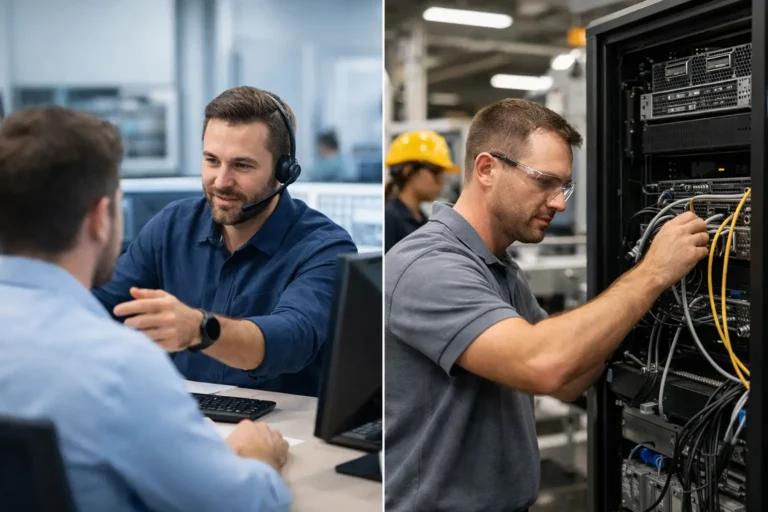
A production stoppage rarely begins with a dramatic IT failure. It may start with an ERP login that will not load, a Wi-Fi drop in the warehouse, a shared shop-floor PC that cannot print a job sheet, or a server alert no one sees until Monday. That is why the outsourced versus internal IT decision is not simply about who resets passwords. It is about who takes responsibility for keeping production, security and compliance moving.
For manufacturers and engineering firms, the right model depends on operational risk, internal capability and the complexity of the estate. A business with a small office network has different requirements from one running ageing machine controls, MRP software, warehouse scanners and separate networks across several sites. The most effective answer is often not a strict choice between the two, but a clear operating model with no gaps in ownership.
Outsourced versus internal IT: what changes in practice?
Internal IT means employing one or more people to manage technology from within the business. They may support users, maintain infrastructure, coordinate suppliers and advise management on improvement plans. An outsourced IT provider delivers some or all of these responsibilities under a managed service agreement, usually with agreed monitoring, support scope, response arrangements and regular reviews.
The practical difference is capacity and breadth. An internal IT manager may know your users, systems and operational priorities exceptionally well. Yet one person cannot be available around the clock, hold deep expertise in every security discipline, manage every supplier escalation and still deliver planned improvement work.
An outsourced provider brings a wider technical team, established processes and specialist knowledge that can be difficult to recruit internally. For an industrial business, that should include an understanding of legacy operating systems, network segregation, ERP and MRP dependencies, ransomware risk and the care required around machinery-connected equipment.
Neither approach automatically delivers reliability. An internal team without time or authority to address known risks can become reactive. An outsourced provider that treats a factory like a standard office environment can make equally poor decisions. The value comes from clear accountability, preventative work and an approach designed around operational continuity.
When an internal IT team is the right choice
An internal team can be the best fit where technology is central to daily operations and there is enough scale to support dedicated roles. Larger production sites may need an on-site presence for rapid physical checks, coordination with engineering teams and hands-on support for a complex estate.
Internal staff also develop valuable business context. They know which workstation supports the inspection process, why a machine supplier has restricted access requirements, and when a planned system change would interfere with a critical production run. That knowledge helps IT decisions reflect what happens on the factory floor rather than just what appears on a network diagram.
However, an internal model needs to be resourced realistically. If one IT manager is expected to support users, oversee cyber security, maintain backups, manage vendors, plan infrastructure changes and respond to every urgent issue, strategic work is usually the first task to slip. The result can be a familiar pattern: patching is delayed, documentation falls behind, ageing equipment remains unassessed and risks are accepted by default.
Recruitment is another consideration. Manufacturing businesses often need a combination of skills that are rarely found in one individual: Microsoft platforms, networking, cyber security, cloud services, industrial connectivity and compliance. Retaining those capabilities internally can be challenging, particularly where the team is small.
Where outsourced IT adds operational value
Outsourced IT is often most effective for small and medium-sized manufacturers that need a dependable support function without building every specialist capability in-house. A managed provider can monitor systems, apply routine maintenance, support users and bring structured cyber security controls into the day-to-day service.
The strongest benefit is prevention. Good managed IT support should identify a failing backup, unpatched device, expiring licence, overloaded server or unusual login pattern before it becomes a production problem. It should also create a clear escalation route when a fault affects critical systems, rather than leaving operations staff to work out which supplier to call.
This matters particularly where technology has accumulated over many years. Many manufacturing sites run a mix of modern cloud services, on-premise servers, old PCs attached to specialist equipment and third-party applications that cannot simply be upgraded. Replacing everything may be impractical or introduce unacceptable disruption. The safer approach may involve isolating higher-risk devices, using jump machines for controlled access, improving backup coverage and documenting recovery procedures.
An experienced outsourced partner can provide this depth across multiple disciplines. It can also give decision-makers more predictable service coverage, with agreed responsibilities and access to technicians when the usual point of contact is unavailable. Syn-Star, for example, supports manufacturing environments with a focus on protecting production continuity rather than treating shop-floor technology as an afterthought.
Outsourcing is not a reason to hand over every decision. The provider should explain risks in business terms, make practical recommendations and work around production schedules. If a proposed change cannot be safely completed during operating hours, that should shape the plan.
The risks to test before outsourcing
The wrong outsourced arrangement can create distance between IT and operations. Be cautious if a provider cannot explain how it will handle machinery-linked devices, unsupported systems or vendor-controlled equipment. A generic promise of support is not enough when a network change could affect a production line.
Before appointing a provider, establish who owns the following areas:
- User support, including shift workers and shared devices
- Monitoring, patching and endpoint security
- Backup testing and recovery responsibilities
- Network design, Wi-Fi coverage and segregation
- Supplier management for ERP, MRP, machinery and telecoms
- Cyber incident response and communication with senior staff
A clear responsibility matrix prevents the costly phrase, “We thought the other team was doing that.” It should distinguish between systems the provider manages directly, systems controlled by a specialist vendor and areas where your internal team must approve or carry out work.
Response commitments deserve close attention too. A support desk that answers quickly is useful, but the real question is what happens when an incident threatens output. Manufacturing firms should understand emergency response arrangements, out-of-hours coverage, escalation paths and whether the provider has the tools and access needed to act quickly.
The hybrid model: often the most practical option
For many businesses, outsourced versus internal IT is a false either-or choice. A hybrid model combines internal operational knowledge with external capacity and specialist support.
An internal IT lead can own relationships with production, finance, engineering and senior management. They can prioritise changes around operational needs and retain oversight of the technology roadmap. The outsourced provider can then deliver monitoring, helpdesk capacity, cyber security expertise, project support, holiday cover and access to a broader range of technicians.
This model works well when responsibilities are deliberate. The internal lead should not spend every day resolving routine tickets that a managed service can handle. Equally, the provider should not be excluded from discussions about new machinery, site moves, software changes or compliance requirements until the last minute.
A useful rhythm is regular service reviews that connect technical work to business risks. These reviews should cover recurring incidents, patching status, backup recovery tests, cyber security findings, lifecycle plans and upcoming operational changes. They are not meetings for reporting ticket numbers alone. They are where the business decides what must be improved before it causes downtime.
How to decide which model fits your business
Start with the consequences of failure, not a preference for internal control or external support. Ask how long the business could operate if the ERP system, factory Wi-Fi, file access or key production workstations were unavailable. Then consider whether the current team has the people, skills, tools and time to reduce those risks.
Review your technology estate honestly. A straightforward cloud-first office setup may be manageable with limited internal resource. A multi-site manufacturer with legacy hardware, segregated operational networks and critical supplier-managed systems needs broader planning and documented recovery arrangements.
Cost should be assessed as the total cost of dependable operation, not solely a comparison of salaries and monthly support fees. Include recruitment, training, absence cover, security tooling, monitoring systems, specialist consultancy, delayed projects and the cost of avoidable downtime. A cheaper-looking arrangement can become expensive if routine work repeatedly prevents risk reduction.
Finally, consider accountability. Your chosen model should make it obvious who is responsible for raising concerns, approving changes, maintaining documentation and acting during an incident. If the answer changes depending on who is asked, the model needs attention.
The right IT arrangement gives production leaders confidence that technology is being watched, maintained and improved without distracting them from delivery. Whether the capability sits mainly in-house, with a managed provider or across both, the standard should be the same: fewer surprises, faster recovery and decisions that protect the next production run.